Saturday October 15th 2022 (and more if you're so inclined)
UTLMBY — what is this strange beast?
Let's take the initials one by one:
- U -> Ultra
- T -> Tour
- L -> Lac (Lake)
- M -> Monteux
- B -> Back
- Y -> Yard
(and CR means "Compte-Rendu" — race report)
OK, let me unpack that a bit because it may still not be clear. A few years ago Laz, an American, a genius runner and race organiser, had the brilliant idea of organising a race he called a "backyard". A back yard is really the little patch behind the house — we're not talking about a neatly-manicured French garden with cone-trimmed trees. No, picture Laz at his place in Tennessee, with a piece of land behind his house, organising a race whose rule is simple: every hour on the hour, the runners set off and must complete a 4.167-mile loop (6.7 km).
That's it. 4.167 miles in one hour. A little loop behind the house. Way too easy. Ah, except it's every hour. Every hour, but until when? Until there is only one person left on the course. So when do they rest? Between loops — if you finish a loop in 55 minutes, you've got 5 minutes to rest. What about at night? Night too, you keep running loops. So when does it end? I just said: when only one person is left running. Keep up, we're not going to repeat the rules 40 times either...
Some numbers about backyards... The reason for that 4.167-mile cadence is calibration: it gives exactly 100 miles in 24h. And 100 miles a day is a very interesting distance, because it's both a symbol and not that easy to keep up, especially over several days. For context, a guy just ran almost 200 miles in 24h, so very high-level 24h performance is well over 100 miles — close to double, actually. But on day 2, that drops... And over 6 days, one of my favourite race formats, the world records sit at barely more than 620 miles, and performances over 600 miles can be counted on the fingers of one hand since the start of this century. Bottom line: even if you were allowed to set your pace however you wanted, doing 600 miles in 6 days is very (very) hard. And with this added "one start per hour" rule the exercise gets harder still.
At the time I take the start of this Backyard, which happens in Monteux, in Provence, the world record is 90 hours. My personal best is 46 hours, set in 2020 — looks tiny in comparison. This edition is a bit special. Unlike the "open" race held one week later on October 21st, where anyone can register, this one is invitation-only: each country picked 15 runners, trying to take the best they could each time, and each country runs its own Backyard, in its corner, but everyone starts at the same time. Then there's a points classification where you add up each country's laps, and each winner of a "local" backyard is selected to go to a final, which will be held next year, in 2023, in Tennessee, in Laz's country. I should have gone in 2021, but COVID happened, and I couldn't travel.
A last point about the rules: the last person to finish a loop wins, but he or she must stop right after. Which means... the performance depends not just on you, but also on others who are there to push you in front, in case you are the last one in the race.
I'll stop bothering you with these details, let's get to the facts.
The course
I can't remember the first loop. It's too far back. I think I was mostly worried about getting lost. It would take me several loops to really find my way. The organiser, Philippe, whom I've known on 6-day races, did his best, and the course is flat, varied, and rather pretty.
But... there is a thing. You pass through the same spot twice, in the same direction. My fear was missing the lake loop, or doing it twice. Basically the course zig-zags mostly on roads, with a few paths, and at one point you have to turn right to go around the lake, then once you've done the lake, you have to turn left to come back to the stands.
Philippe seems to think it's simple... I quote: "you'd have to be drunk to mess this up!" And he's not wrong. But a tired runner doesn't think much more sharply than a drunk guy.
In practice I had one or two moments of doubt, especially the first day, then I was so dialled in that I'd pass almost to the minute at the same spot, every loop, so I knew "if it's 31 minutes, right; if it's 43 minutes, left".
Logistics
The nice thing about these races with only 15 runners is that for crewing, it's simpler — there's space, easier use of the area.
In my case I had a chair, a half-table shared with Charles, a camp bed, lots of supplies bought at the supermarket before the race, and above all Valérie who handled all that masterfully.
What does "masterfully" mean? It means that over more than 2 days, she was there at the end of every loop. Every single loop. Not one loop where she was replaced. She got by with little naps of 40 minutes max.
It means she made sure I had my gear at every start, reacted in a flash when I asked for one shirt, a custard cream, a coffee, a syrup. Whatever, all ready in 10 seconds flat.
That makes a phenomenal difference. I know how to run alone and manage my own logistics. But it takes me time. Here I had a routine, fairly similar on every loop.
The routine
- H:00 start! Walk.
- H:05 I start running.
- H:35 I stop running and walk.
- H:50 I arrive at the stands, sit down, eat and drink, give instructions.
- H:52 lying down, eyes closed
- H:57 driiing-driiing-driiing 3 minutes left, I get up and put my shoes on
- H:58 driiing-driiing 2 minutes left, I eat, drink, adjust clothing if needed
- H:59 driiing on my feet, off to the starting zone
- H+1:00 ^ off we go again
That was the baseline plan. But like all plans, you have to adjust to "reality". You have to adjust your plans — I made the mistake, a few years back, of being too strict.
The big trick is not to immediately say "nah, plan is busted, I'm going manual, by feel". Right.
What I do instead is observe, loop after loop, whether my routine, my plan, suits me, and I adjust little by little. It's adjustment, very often.
Example: I noticed I was spending about 30 seconds putting my shoes on. I don't undo my laces so normally it's fast, but I had blisters on my heels and putting the shoes back on was painful, so it was slow. I don't like to suffer. So I told myself — sure, it's good to take the shoes off to let the feet breathe, but today, it really hurts when I put them back on, and I have the impression that this operation makes the blisters worse. So I decided not to systematically take my shoes off. So the end of the routine becomes:
- H:57 driiing-driiing-driiing 3 minutes left, I stay lying down and enjoy a good extra minute of rest tucked into my bed, all comfy
- H:58 driiing-driiing 2 minutes left, I eat, drink, adjust clothing if needed
- H:59 driiing on my feet, off to the starting zone
Then, when there were fewer of us, and once I was reassured about logistics, I shifted the moment when I'd head over to the start area from H:59:00 to H:59:30, i.e. 30 seconds later.
And then with time, I slowed down... I was running slower and slower. From 6 mph, my running pace dropped to 5.5 mph, then 5 mph. What to do?
I replaced walking with running.
So at one point, the start of my routine became:
- H:00 start! Walk.
- H:03 I start running.
- H:38 I stop running and walk.
- H:50 I arrive at the stands, sit down, eat and drink, give instructions.
I.e. 5 more minutes of running.
Then what had to happen, happened, and it ended up as:
- H:00 start! Run.
- H:48 I stop running and walk.
- H:50 I arrive at the stands, sit down, eat and drink, give instructions.
Which means, basically, I run all the time except for the last 200 or 300 yards before arriving. One of the guys watching the course on a bicycle remarks, near the end, "but you're running all the time?!"... Well yeah, not much choice. To each their technique — not the most elegant, this one works. I ran like a snail, walked like a toad, but at the end the loops come in on time.
From a certain angle, I still had margin: I could scrape another minute by running the few hundred walked yards each loop. And maybe I could have pushed myself to run faster — I stayed at my endurance pace, my natural "I want to last veeery long" stride.
The thing is, based on prior experience, once I've dropped to 5 mph I slow down very little, so I think (without being certain — that's the charm of the thing) that the problems I'd have had if I'd kept going much longer would have been of a different nature.
What I learned
I observed a lot. That's the key — you have to look around and learn. For example I watched Charles's last loops closely. He was one of the first to have to cut his effort, and he battled hard to squeeze in a few more.
What happened in those last loops? He was cooked. He did loops starting slowly because he couldn't run, then at the moment the course turns very (and I mean very) slightly downhill, he picked it up, but he still had more than half to go. And what happens? It turns out I cross paths with him around the lake — I've already done the lake, he hasn't, maybe I'm more than a mile ahead, and he has to run almost 6 mph to finish on time, because he has more than 1.5 miles left. But he makes it! I noted his split. 41 minutes after the little bridge but before the fork. I file it away for later: even if I pass there at 41 minutes, with a lake loop still to do, it doesn't matter, nothing's decided, I can still make it!
In short, on the last loops, and that's the principle of the race, you're cooked. But anything goes, the only rule to respect is to bring the loop in under 0:59:59. The rest doesn't matter. There's no score for style. It doesn't matter how long you took on the first half of the course; only the result at one hour counts.
Thank you Charles for the demonstration. Very useful. All lessons worth taking.
Another thing I discovered, thanks to Alain David, the man for whom the trumpet and the 24h hold no secret, is this Henri Salvador gem, "Vas-y Mollo".
Sleep
I often get asked: "but do you really sleep?".
Because yes, I spend a lot of time lying down, about 5 minutes per loop, every loop, which, from one angle, is enormous.
The answer is: "yes and no...".
Technically I had the impression I never really fell asleep, even though I spent two full nights on the course.
From another angle, observers heard me snoring.
Whom would you like to believe?
Does it hurt?
Well, I can't answer for others, but as far as I'm concerned, yes it stings a bit.
I have the "luck" (a relative kind of luck, somewhat self-provoked) of rarely getting injured, so no knee, ligament or joint problems, none of that.
Just muscular pain (to be expected...) and chafing problems. Chafing problems made worse by a little killer detail: at the moment (for a runner) I'm genuinely heavy, more than 187 lb for 5'11''. So, it rubs. Skinny people don't know what chafing burns are. Here we're in heavy territory, with in particular the crotch completely ruined from hour 20, the moment when I decided to stop wearing underwear because it was unbearable.
Poetry lovers, good evening.
Examples to follow
A few weeks earlier I was in the crowd at the Cabaret Sauvage watching a chess-boxing fight. Why was I there? Long story short, it's my mental coach status that took me there.
So what did I see? Chess-boxing of course! What, some of you don't know it? OK, let me explain. They play chess for 3 minutes, time controlled. Then hop, the joyful combatants put on the gloves, and BAM! A 3-minute round of boxing. Then back to the chess game. Then back to boxing. Etc.

Until someone takes a KO, or one player is checkmated, or runs out of time. In short, the first to win, at chess or at boxing, takes the match. The whole thing fits within about half an hour.
It's Valérie, my wife, who pointed out that this is not so far from a backyard, because of that aspect of "after a round, of boxing or chess, you have to set off again, and the first one who falls...".
And there's a second commonality: the backyard format really reminds me of the book The Long Walk, by Stephen King, just as chess-boxing is directly inspired by the graphic novel Cold Equator, by Enki Bilal.
So during this superb evening, we had 4 fine fights, including a final between, I quote: "Jules (26 years old, student, 3 fights, 3 wins) and 2019 world champion, faces Carl (39 years old, chess teacher, 9 fights, 9 wins) pioneer of chess-boxing and world champion in the English league. Between Jules and Carl, who will know his first defeat?"
OK, having seen the fight, it was epic. Jules, in his bio, lists with panache "profession: brawling". I confess, that one killed me. Excellent. And in the ring, wow, he wasn't bluffing — I was glad to be on the spectator side, because Carl took a real beating. Like, beaten.
But he didn't give up. Near the end he had the worst position on the chess board even though he'd led the start of the game. He was dominated in the ring. But... he won on time. The last chess moves came tac-tac-tac in a single second.
Moral: until it's over, it's not over. You climb back into the ring, and you do the job. You do it well, period.
I thought about them during some of the tougher loops at night, and I told myself "can you picture one of those two saying: oh forget it, I'm giving up, I have something important tomorrow, bye-bye kisses!" ...
Not really.
It's all relative — I just have to do a little loop running-and-walking-trotting, and I love that, running and trotting. So hop, let's finish the loop, no discussion.
For the curious, the Chess-Boxing club of Paris has its doors wide open to everyone — no need to be a chess or boxing ace, all levels welcome.
And there are other clubs all over France, of course.
The lucky break
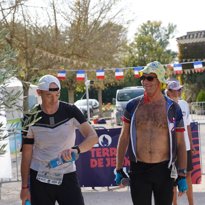
I had the wind at my back. Flat course. Great weather. Unlike Millau, 3 weeks earlier where I had the runs just before the start, this time I was good, no worry. The French team was friendly — they even agreed to laugh at my bad on-course jokes, which isn't always easy.
A huge bravo to everyone with a special mention to Claire Bannwarth who does everything alone, without crew, "one again" style, and also to Sébastien, who pushes me to the 51st loop, going himself to chase the symbolic 50-loop mark. Thanks Séb.
And so I have a ticket to go to the final next year, in 2023.
There I'll be up against the best of the discipline. There it will laugh less — as I write these lines the Belgians are in the process of beating the world record, held by these same Belgians, which stands at 90 hours. Excuse my French, they're giving me 2 easy days, and it's not over...
On the other hand, it's beyond my hopes to be part of this party. I did this backyard at the end of the season, after mostly cycling in 2022 for the RAAM, I missed the 2021 final because foreigners couldn't travel to the USA, I showed up at the starting line with overweight luggage that would normally be unacceptable for high-level endurance sport... but here I am, back in the game, and I'll have the chance to mix with the best.
With an enormous probability of taking a serious thrashing on site. I have maybe a one-in-a-million chance of finishing on top but... as the wizards of Terry Pratchett calculated, "one-in-a-million chances come true nine times out of ten".
Bilan
51 loops, 51 hours, i.e. 212 miles. 8th place for the French team with 525 loops cumulated.
See the full results
EDIT -> after more than 4 days of racing, they finally finished. The Belgians Ivo Steyaert and Merijn Geerts called recess. Or rather no, they're both classified "DNF" (Did Not Finish) because they stopped, together, after 101 loops. 101 loops, 421 miles in 4 days and 5 hours... And so officially, neither is a "finisher" because to qualify for that "title" you have to finish alone. Having done half of what they did (which is to say, nothing) I can assure you their performance is truly remarkable, in the unlikely case that you doubted it.